One Assessment, an Ongoing Experience
I want to clarify a few things as I begin:
1) It is the second day of school and my brain is a combination of spaghetti, mashed potatoes, and weird middle school slang that doesn’t make sense to me.
2) This is absolutely not the only way I am assessing students. This is a very segmented approach (intentionally), but it runs alongside a more complex, integrated assessment like a piece of writing, project, etc.
With that out of the way, writing has always been my way of really processing my own thinking and helping me clarify what I’m aiming to do. This is going to be one of those posts - an idea, albeit half-formed, that I’m trying to pursue to take an existing practice and make it more effective.
The existing practice (to no one’s surprise) starts with my use of learning progressions. If you haven’t read anything I’ve posted about learning progressions, I would recommend you start by reading this post and/or this one.
In short, a learning progression deconstructs a standard into (a) a concise learning outcome and (b) tiered and concrete steps that scaffold content complexity up to proficiency.
If you need to see it, here’s an example:
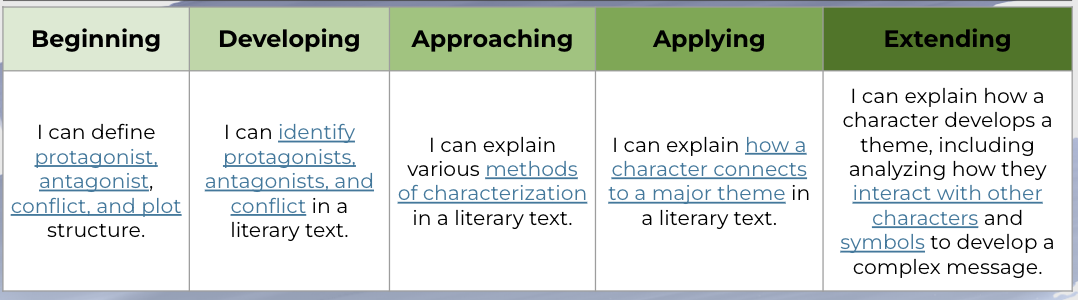
These are the foundation of nearly everything I do in the classroom. They are literally on my walls, and I point to them every day. Lessons are tied to them, reflections are centered around them, even grades (blegh) are based on them.
However, it wasn’t until a few years back that I then went the next step and started designing assessments around these learning progression. Like, really, really, intentionally designing the assessment around the learning progression.
Click here to see an example of what this looks like (and click here to make your own copy).
I absolutely love this assessment design. I have never seen students more able to (a) identify their area for growth and (b) access resources to further their learning independently. Truly, this assessment design is the first time I’ve thought, “I think I’ve found the core of the learning in my classroom” (and I’m saying this having worked on the side as an educational consultant for almost ten years now…which is kind of wild to say).
HOWEVER.
I had to add some drama in there.
The issue for me is that I wasn’t using the assessment how I wanted. It was still sort of a one-and-done approach. Kids would take the assessment, find where they were at, and then we would never revisit it.
The New Goal
This year my goal is that students experience a much more ongoing, cyclical approach to assessment than in years past.
What will this look like?
Entry Tasks and Exit Tickets
I don’t know why I have been creating new entry tasks and exit tickets to assess learning when I have one already built. Instead of an isolated activity, I can now say, “Pull out our mastery check. Whatever phase you were struggling on before, see if you can do it now,” or I could be more targeted and say, “I want everyone to revisit the ‘Approaching’ phase and add new information you learned from the lesson today.”
Additionally, as an entry task, this will help me differentiate a lesson. For example, coming up I have a station activity built to review plot structure and another station to extend students’ thinking by exploring ways authors break the typically plot structure timeline. My entry task will be for students to do a phase of the assessment that ties to plot structure, self assess, and then use that to determine their station for the lesson. Again, it’s premade. I’m not making a new assessment, but rather, using an existing assessment better.
Note Taking
Let’s say students attempt a phase of the assessment tied to the lesson for the day as an entry task. Instead of taking out a separate piece of paper, students could take their notes directly on the assessment itself. Now, not only do they have something to self-assess with, but they also have something to add new learning and keep it in an organized manner that connects directly to the learning progression.
Re-assessment
This is going to be reminiscent of the concept of test corrections, but with a bit of a twist. Instead of giving students multiple different pieces of paper to provide additional attempts to demonstrate their learning, my goal is to use the same one. Here’s what I mean. If you look at the bottom of each section of the assessment, students rate how well they feel like they understood that section. My approach is typically to say, “Stop after your confidence drops below a 5.” This means students aren’t actually completing the entire assessment.
However, the next time we do a formative assessment to figure out what they know, they simply pick up where they left off (with additional feedback from me helping target their real level of understanding). Now, in the same assessment block, I can provide a differentiated assessment experience where some students are attempting to demonstrate understanding of foundational concepts while other students are demonstrating levels of mastery in the same learning progression. This can all happen at the same time without handing out piles of different paper.
Additional bonus: instead of marking and providing feedback on multiple full assessments, I’m only doing a small section of the assessment per student.
The “Dream Big” Plan
Poor technology is getting absolutely destroyed in the media right now, and in some ways it is absolutely warranted. The data looks bad, but I also think there’s an element where the data isn’t accounting for what it should be looking at.
I don’t want to know whether or not technology is harmful to student learning. I want to know the assessment approaches and learning design make technology effective. I have a hunch that when learning outcomes are made explicit, are tiered to leverage the goal gradient theory of motivation, and are clearly tied to assessment designs to that facilitate effective self-reflection, it’s going to be a lot more effective than a task-oriented, grades-focused, completion-driven classroom.
With that little aside, my future steps with this are to be more intentional in crafting curated digital resources tied directly to the phases on the assessment that students can use independently to push their own learning. While I often have them available, I don’t make them an active part of the class. Imagine for a second that students complete a portion of the assessment and then, instead of waiting for feedback and a future lesson, are able to identify a set of resources that they can use to learn the concepts they are stuck on, finished up with a follow-up attempt at the same assessment to see if they grew. While this is happening, I am freed up to pull groups of students struggling with the same phase of the assessment to better be able to target that small group instruction.
I know that sounds like a daydream, but I truly believe that this assessment design paired with a little more intentionality about how I design my learning experiences is a possibility.
And this is all happening while students are hitting the sea lion, mumbling 6-7 sheepishly (but they can’t help themselves because it is now an involuntary reflex, even if it’s not cool anymore), and telling me things like the fact that their favorite color is thunder, their favorite snack is hamster, and that I '“seem like a person who knows how to juggle” (all things said to me in just two days of middle school, and yes, I am still processing what the last comment even means).
You get all that in a room together, and that sounds like a little slice of heaven to me.