A.I. & the Environment: Conscious Consumption & Powerful Creation
To those who read my blog purely for educational content, this is somewhat connected to that, but deals with a much more general concept. Just didn’t want you to be surprised.
We have the capacity to save the world, but as a collective human race, we are choosing to use it to destroy the world instead.
Let me explain.
We now have the technological capacity to do things like:
Improve the ability for medical diagnoses for things like strokes and analyze biomarkers to identify diseases much earlier
Revolutionize the education sphere through enhanced personalized learning and improving student self-efficacy and learning-focused mindsets (I am definitely not overlooking the challenges AI presents to education, mind you)
If you haven’t caught on, I’m talking about the rapid advancement that A.I. has experienced in the past few years. To clarify, A.I. isn’t new. It’s really been around since the 1950s, but its growth was slow. The 90s saw some advancement as the internet helped with the sharing of data, but the biggest jump happened around 2020 as computing capacity finally reached what was needed for the massive requirements of generative A.I.
But then, fast forward to today. If you open up any social media app, you will be bombarded with A.I. generated video, images, and text designed to mindlessly entertain at best, intentionally deceive and manipulate at worst, and throughout this entire spectrum is the desire to steal more and more time away from the user simply to line the pockets of the developers and “creators.”
For now, I’m going to skip the existential crisis as part of my argument. By this, I mean that as a populace, especially in the U.S., we are nowhere near where we need in terms of critical thinking and cognitive bias awareness to be able to handle the impact of generative A.I. on a geopolitical scale. Generative A.I. has risen to prominence at a time when critical thinking feels to be at an all-time low, and that is a recipe for cultural and political disaster.
As an educator, teaching students to think critically about their media consumption, analyze sources of information, and confirmation bias should be of utmost importance if we want to move through this time with any sense of dignity as a society.
But, as I said, that is not the crux of my argument here.
The reason I get so angry seeing my feed filled with A.I. slop is because I love nature.
Bear with me here.
Many people aren’t even aware of the environmental impact of A.I., and that’s partially by designed, as it doesn’t sell well when you’ve created a product that’s using earth’s resources at an exponentially increasing rate.
Now, I have heard this over and over, but I wanted to do some digging. Is it true that generative A.I. uses more resources than other technology and is actually doing increasing harm on the environment?
Well, the answer is yes, and a little bit of no.
If you want to fact check, here are some sources:
New Data: AI Is Almost Green Compared To Netflix, Zoom, YouTube (I have to laugh because this study was put out by a data center construction company, and some of the information they share is STILL concerning)
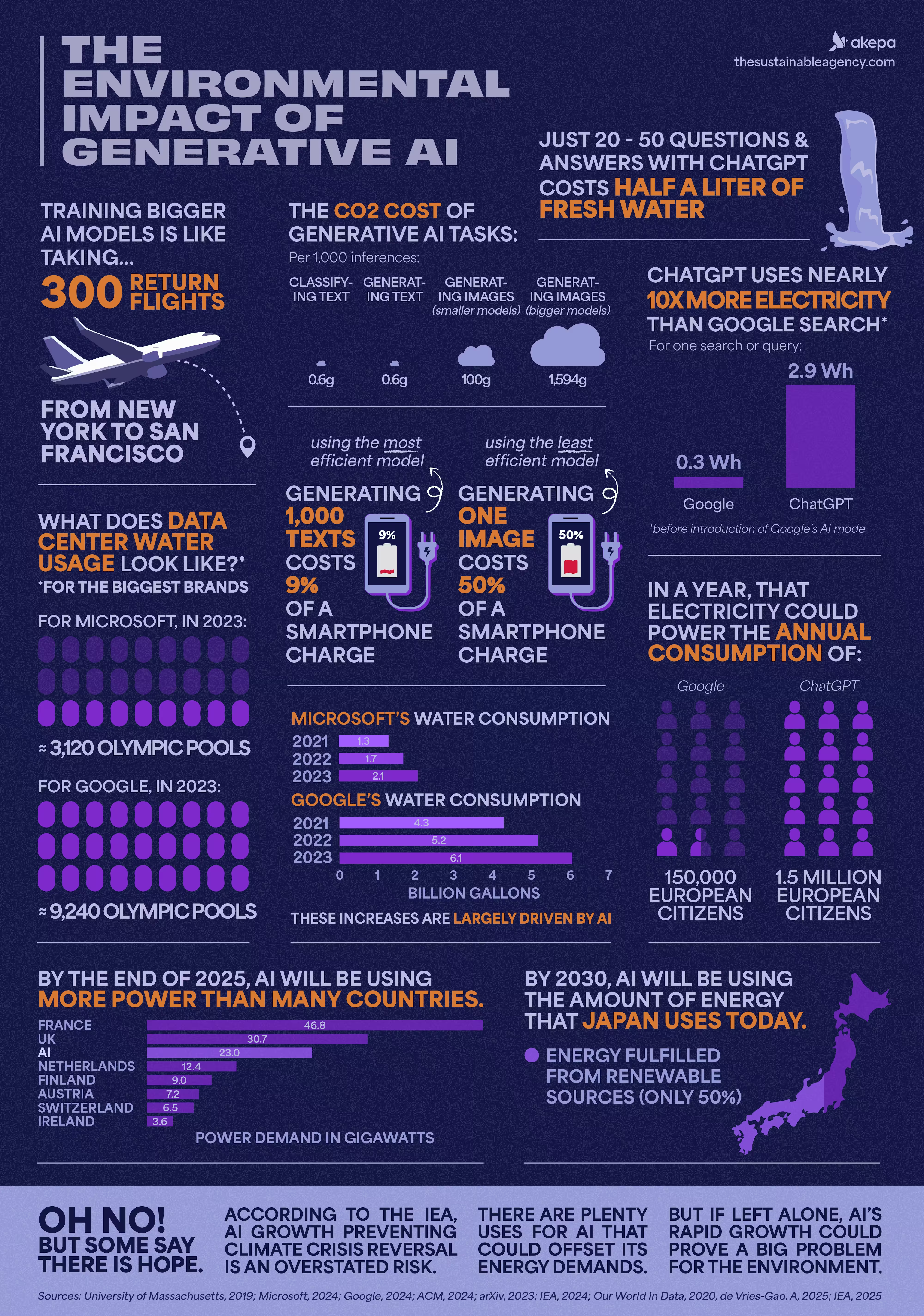
Is it true that a ChatGPT query takes about 10 times the power of a Google search? Yes.
Is it true that a single A.I. generated image has an approximate carbon footprint of 1 g CO2 (the equivalent carbon footprint of a 100W lightbulb run for a little over a minute)? Also yes.
Does a 6-10 second text-to-video creation take the same amount of power as an hour on Zoom? Surprise, surprise. Yes.
Is it true that by the end of 2025 (surprise, we’re here) A.I. will be requiring more power than countries like Finland, Ireland, or Switzerland? You guessed it. YEP!
HOWEVER, we can’t just completely blame A.I. for all our energy woes. A ChatGPT query takes about 2.9 watt hours of electricity while streaming Netflix or YouTube for an hour takes about 120 watt hours. Realistically, there are a LOT more people out there watching hours of Netflix or YouTube on end than there are asking ChatGPT 40 questions every hour.
So, is generative A.I. solely responsible for the energy crisis? Absolutely not.
Is it a contributing factor and growing rapidly as a leading consumer of resources? Yes.
I won’t deny that A.I. is a rising contributor to the energy and climate crisis happening in the world.
That alone concerns me, but it’s not what makes me mad. As I mentioned at the beginning, generative A.I. and predictive A.I. have the potential to make advancements for humanity and the world that have never been seen before. This would be an incredible use of resources. Just like using grain and water to make bread so that it provides life-giving calories to someone is an incredible use of resources.
However, where I’m mad is that we are doing the equivalent of making bread and then feeding it to ducks (which, for the record, actually is really bad for ducks and makes them sick – the birder in me needed that sidenote). We are using up resources to make our society sick with misinformation and bloated with mindless content as we waste the potential of generative A.I. by instead wasting resources on social media A.I. slop so that some tech CEO can line their pockets with more advertising and data-sale revenue while the earth suffers for it.
Brace for an admittedly-rough transition.
A few years back I stopped just saying “Reading and Writing” in my English classroom and instead started saying “Critical Consumption and Powerful Creation.” To focus simply on reading and writing, preparing students only to engage in those mediums doesn’t reflect the reality of what their brains will need to in their future.
I wanted students to realize that what we were talking about – evaluating sources, analyzing word choice and tone, and understanding symbolism – had just as much to do with a video they watched on TikTok as it did about the article we were reading in class. I wanted them to think about a news article they saw online when we talked about word choice just as much as they were thinking about the novel we were reading as a class.
Then I wanted them to broaden that thinking. We read articles about cell phone usage and screen time and talked about how that was a consumption of our most valuable resource: time. We talked about how consumption of that wasn’t in-and-of itself a bad thing, but rather, that we needed to be a critical consumer and ensure that our resources were being spent somewhere that aligned with our values.
We wrote argumentative papers about things like the environmental impact of electric cars versus gas vehicles or the benefits and drawbacks of predator reduction tactics in conservation efforts. I wanted my students to think about critical consumption on a grander scale. As a society, are we using our resources in a way that aligns with our priorities and values?
I wanted those students to grow up to be people who see an A.I. generated video on TikTok, can recognize it, and then really reflect on the act of consumption involved in both the creation and the reception of that video.
Because the part that bothers me about generative A.I. and how it’s impacting the environment isn’t simply that it’s consuming resources; it’s that its consuming resources in a completely uncritical way. We use resources for a purpose that aligns with our values and we do so thoughtfully. That is critical consumption.
The use of generative A.I. by and large in the modern world couldn’t be further from this definition of critical consumption.
This.
That simple disconnect of resources from values.
This is what upsets me.
It’s like we have a choice to limit the ways in which we use A.I. so that we can reap the benefits while minimizing the negative impact on the environment, but instead we are forging ahead with mass-marketed technologies to create a fake video of a bird that poops rainbows and makes calls in the voice of Morgan Freeman, which your distant relative sends to you with a message that says, “I can’t believe this bird exists,” while fully believing that this bird is, in fact, somehow real.
But, believe it or not, while this lack of conscious consumption angers me the most, it’s not what truly makes me sad, discourages me, about this situation.
What brings me down is that it demeans the second part of the phrase that I would repeat with my students: powerful creation.
To be honest, I don’t know where I stand in terms of A.I. enhancing elements of the artistic process. As a photographer, I use generative tools to remove distracting branches or identify a subject for a masking tool. I am open to the idea that generative A.I. could potentially have a place in art.
What I’m not open to is the mass production of pointless and false videos on the internet crowding out the humanity and hard work of individuals who have not only poured their time and talents into their art, but they have also poured pieces of themselves, their heart and soul, into their work.
I’m not open to sending future generations the message that art doesn’t need humanity or that it is more important to be entertaining than it is to be powerful, to create something of true value to the world. That art is something you can create in a few clicks, with no hard work, and with no mental or emotional contribution.
The hardest part is that I wish I could end this article with a solution. I wish I knew what regulations or pricing model changes would keep people from mindlessly generating A.I. videos. I wish I knew how to snap my fingers and change the education system to truly prepare students to be conscious consumers and powerful creators in the age of generative A.I. I wish I knew that the scientific advancements of A.I. will create a more powerful, efficient, and environmentally-friendly form of energy that will more than offset the cost demanded by it.
I wish I knew that and so much more about how to solve this problem, but I don’t.
I do know one thing, though. In any sporting event, it’s not the team that determines the outcome of the game. Rather, a win or loss is based decisions and efforts of every individual out there on the playing field.
Should we hold these corporations and government entities accountable? Yes, as best we can. Sign the petition. Post on social media. Call your representatives.
But on a less grandiose scale, as we head into a new year, skip the A.I. generated profile picture and instead post your amazing self as you really are. Instead of creating a funny video with generative A.I. to make your friend laugh, pick up the phone and call them. When you could use ChatGPT to write a letter of recommendation for a colleague or friend, choose to write it with care instead. Think about the true cost of what we might do with A.I. and then think about your values.
Sure, it is likely that we may need to rely on A.I. as a way to improve the future, but for so much of what we are tempted to use generative A.I. for right now, make the choice instead to rely on and celebrate the most abundant resource we have – our humanity.